Yosemite Firefall (Horsetail Falls): What to Know Before Visiting in 2026
Planning to see the 2026 Yosemite Firefall? Get expert timing tips, parking strategies, and photography advice from an award-winning Yosemite photographer. Plus, discover the story behind the rare heart-shaped Firefall mist.
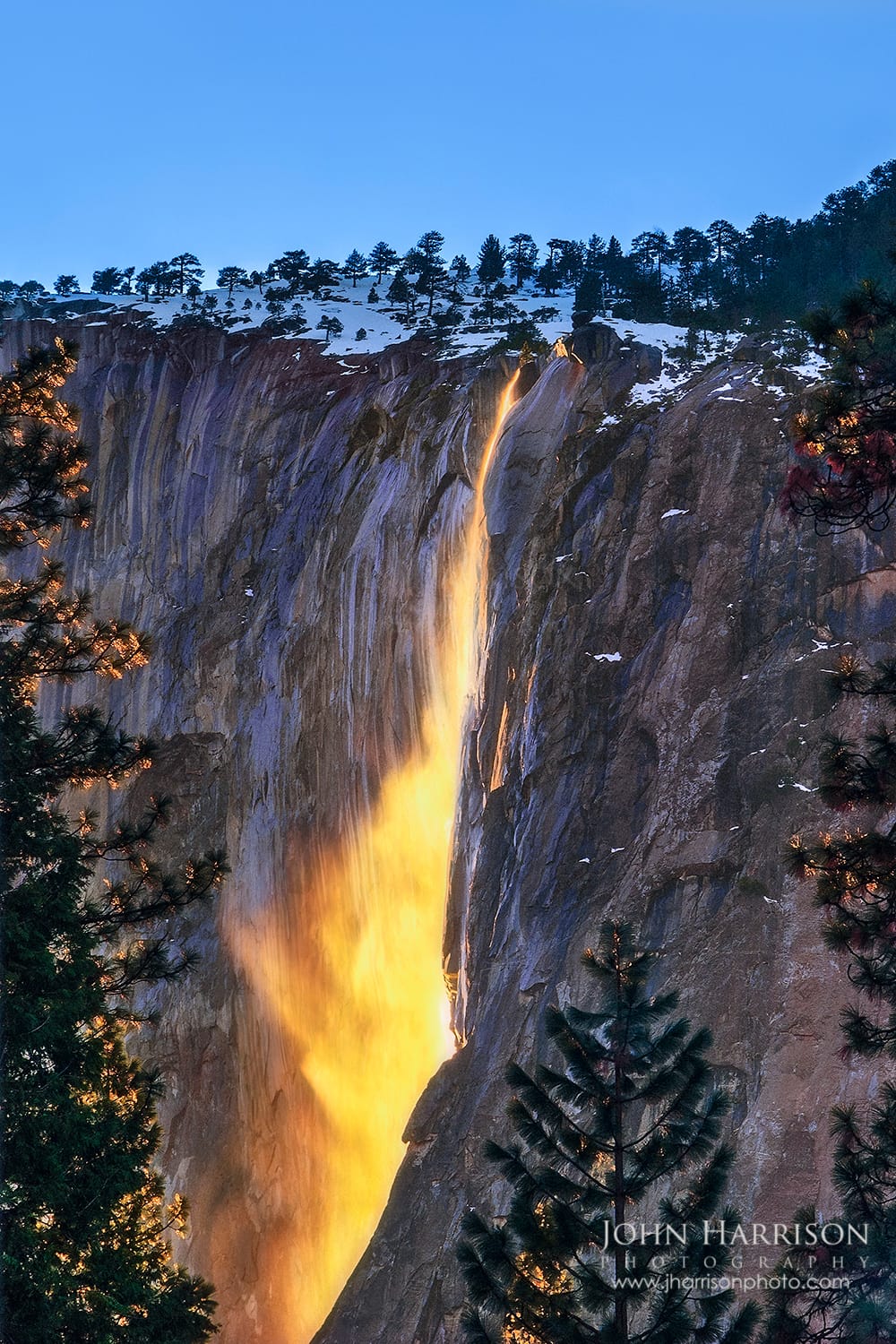
A Yosemite photographer’s guide to timing, expectations, crowds, and experience
TL;DR — Yosemite Firefall (Horsetail Falls) Quick Guide
- When: Mid to late February (exact dates vary each year)
- How long it lasts: About 5–10 minutes near sunset — if conditions align
- What’s required: Flowing water, clear western skies, precise sun angle
- Crowds: Very high near sunset — arrive early and expect to walk
- Do you need to hike? Yes — plan for 1.5–3 miles of flat winter walking
- Photography: Long lenses isolate the glow; phones capture the moment, not the detail
- No reservations (currently) for 2026: The NPS page currently says no reservation is required for February 2026 — which likely means heavier crowds. Always re-check the official NPS Firefall website before before your visit.
Want to know where to go, what to expect, which roads may be open or closed, and how to plan your visit?
Keep reading for a realistic 2026 Horsetail Falls visitor guide — written by a Yosemite photographer with nearly 30 years of experience and a nationally award-winning Yosemite Firefall Horsetail Falls image.
Get the full Horsetail Falls Firefall field guide (free)
Want the complete 5,000-word version with parking strategy, what to wear, viewing maps, photography tips, and backup plans if Firefall fails?
✅ Join free and I’ll send it to you.
Get the full Horsetail Falls Firefall field guide (free)
Want the complete 5,000-word version with parking strategy, what to wear, viewing maps, photography tips, and backup plans if Firefall fails?
Join free and I’ll send it to you.
Didn’t get the shot you were hoping for?
Some moments in Yosemite can’t be forced — even when you plan perfectly.
Collected for homes, offices, and healthcare spaces worldwide.
Introduction — The 10-Minute Miracle You Can’t Chase
For nearly 30 years, Yosemite National Park has been more than a place I visit — it’s been a second home. It’s where I asked my wife to marry me, where our children learned to love the outdoors, and where I created my nationally award-winning photograph "Nature’s Firefalls – Horsetail Falls at Sunset" back in 2007.
That year, there were only a handful of us standing quietly in the snow, watching something few people even knew existed. Today, Horsetail Falls — often called the Yosemite Firefall — has become a global spectacle.
The crowds have grown. The light hasn’t changed. It's always about the light!
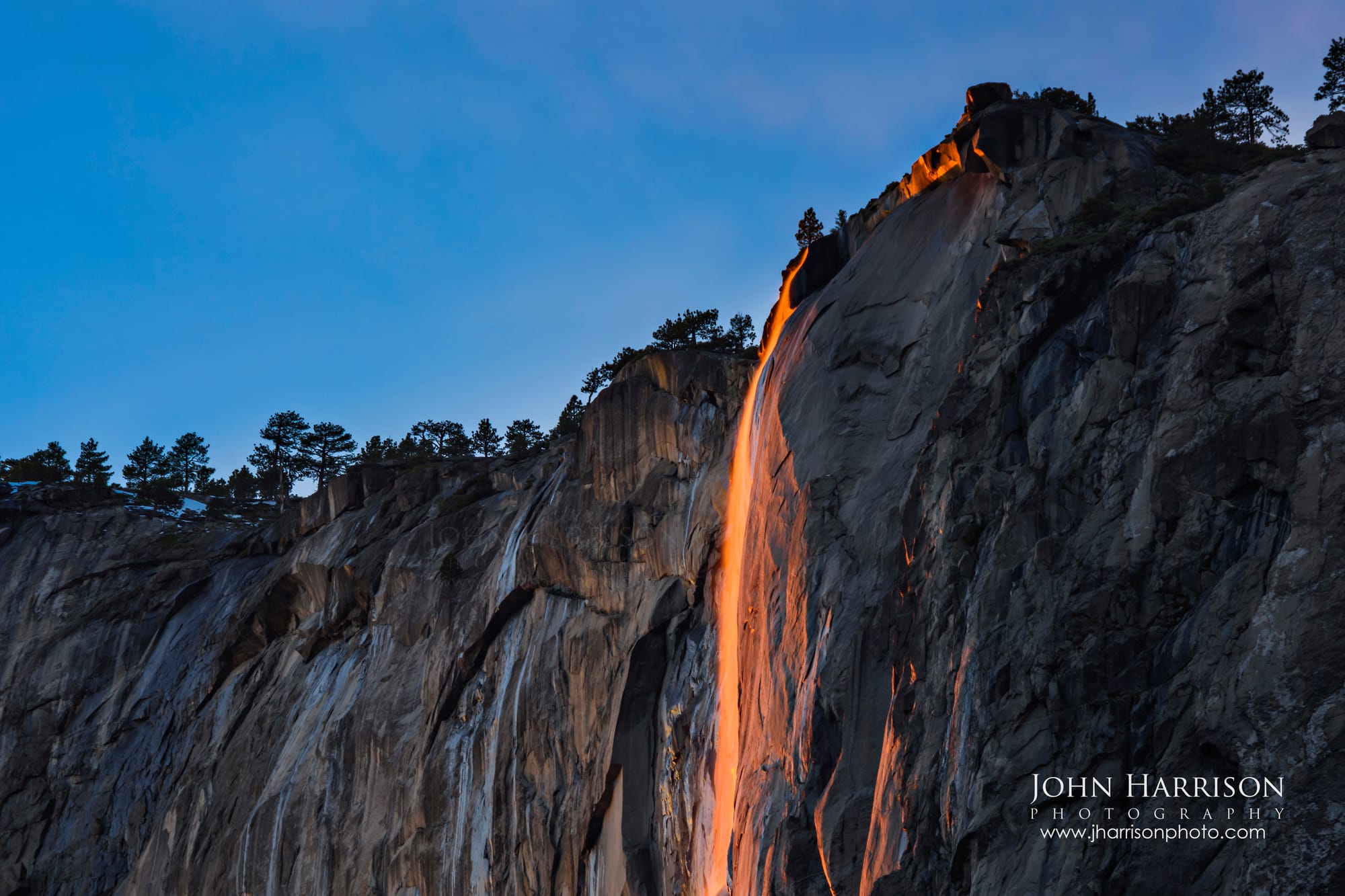
For a few fleeting minutes each February, a narrow winter waterfall on El Capitan can glow orange and red at sunset, appearing like molten lava pouring down granite. When it happens, it feels unreal. When it doesn’t, Yosemite remains Yosemite — calm, powerful, and entirely uninterested in our expectations.
This guide isn’t about hype. It’s about understanding what Horsetail Falls really is, what to expect if you visit in 2026, and how to experience it — whether you arrive with a phone, a camera, or simple curiosity.
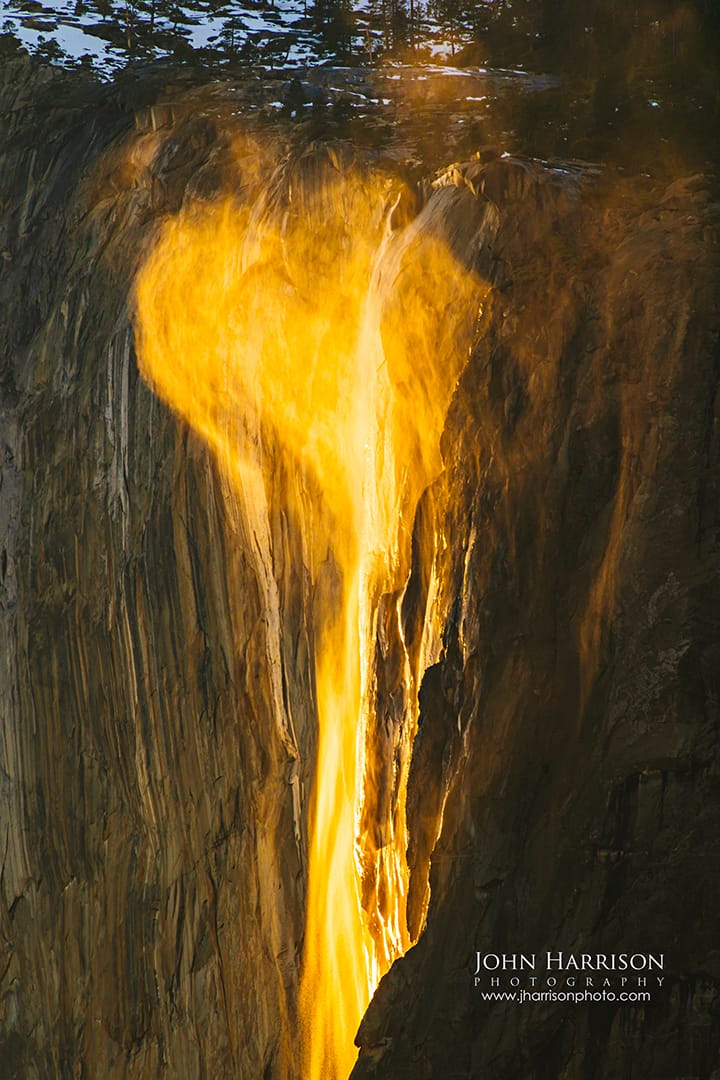
What Is Horsetail Falls — And What Is the Yosemite Firefall?
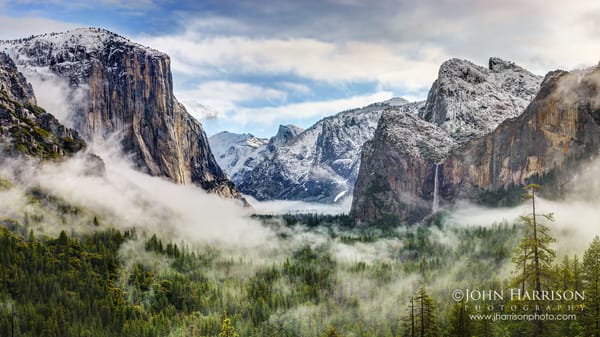
Horsetail Falls is an ephemeral waterfall on the east side of El Capitan in Yosemite National Park. Unlike Yosemite’s large, year-round waterfalls, Horsetail Falls only flows in winter and early spring when snowmelt feeds a thin ribbon of water down the granite face.
The “Yosemite Firefall” is not a separate waterfall. It’s a natural light phenomenon that occurs only when several conditions align perfectly:
- Horsetail Falls must be flowing
- The western horizon must be clear at sunset
- The sun must be low enough to strike the falling water directly
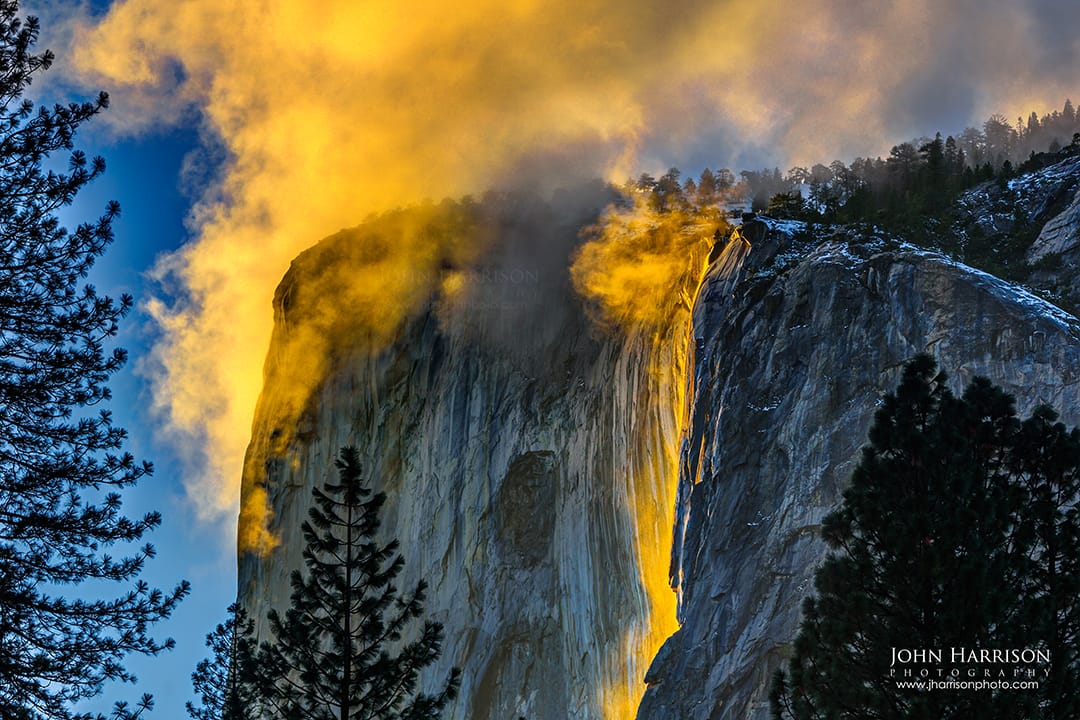
When this alignment happens — typically in mid to late February — the water catches the last light of the day and briefly glows orange, red, and gold. Most years, this lasts only minutes. Some days, it doesn’t happen at all.
A Quick Note on the Original Firefall
Before today’s natural Firefall became famous, Yosemite had a man-made Firefall. For decades, burning embers were pushed off Glacier Point each night as crowds below called out, “Let the Fire Fall!” The practice ended in the 1960s due to environmental damage and safety concerns — and rightly so.
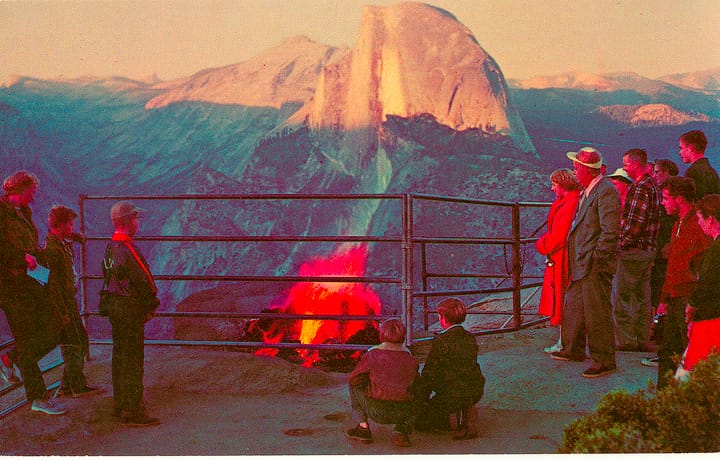
What visitors see today at Horsetail Falls is completely natural: a rare convergence of light, water, and timing. That rarity is what makes it meaningful.
When to See Horsetail Falls in 2026 (Timing & Light)
There is no single “Firefall date.” Instead, there’s a narrow window that usually falls in mid to late February, often spanning about 7–14 days.
Here’s what actually matters:
- Water flow: Horsetail Falls depends on snowpack and melt.
- Clear western skies: Even thin clouds on the horizon can block the low sun.
- Sun angle: The alignment only works for a short seasonal window.
- Evening timing: When conditions align, the glow lasts about 5–10 minutes.
My best advice: Plan a multi-day visit rather than betting everything on one evening. Flexibility matters more than precision. It took me multiple trips to create my image — and many more where nothing happened at all.
Horsetail Falls is unpredictable.
Clouds, snowpack, timing, and crowds all play a role — even with perfect planning.
This image hangs in my own office — a reminder that some moments only arrive when conditions align.
How Crowded Yosemite Gets — And What to Expect
Yosemite Firefall season now brings some of the largest winter crowds Yosemite sees all year.
A few realities to know:
- Crowds are concentrated near viewing areas, not everywhere in the Valley
- Parking restrictions and no-stopping zones are common
- Expect to walk 1.5–3 miles round-trip
- Arrive 2–3 hours before sunset to reduce stress
- Rangers actively manage traffic and safety
If you arrive expecting solitude, Firefall season can feel overwhelming.
If you arrive expecting a shared experience, it becomes much easier to enjoy.
Where to Go, Park & How to Access Horsetail Falls
You do not hike to the base of Horsetail Falls. Most viewing is across from El Capitan, so plan for a winter walk and a long wait near sunset.
Free Yosemite Firefall planning checklist
The Firefall glow lasts minutes — but the planning is hours.
Grab my printable checklist: when to arrive, what to pack, where to park, and how to avoid the stress.
✅ Free download for subscribers.
Free Yosemite Firefall planning checklist
The Firefall glow lasts minutes — but the planning is hours.
Grab my printable checklist: when to arrive, what to pack, where to park, and how to avoid the stress.
Viewing Areas & Parking Map (2026)
I created this simple map to help you understand where to park, walk, and stand during Firefall season. Save it to your phone before you arrive — cell service is limited in Yosemite Valley.
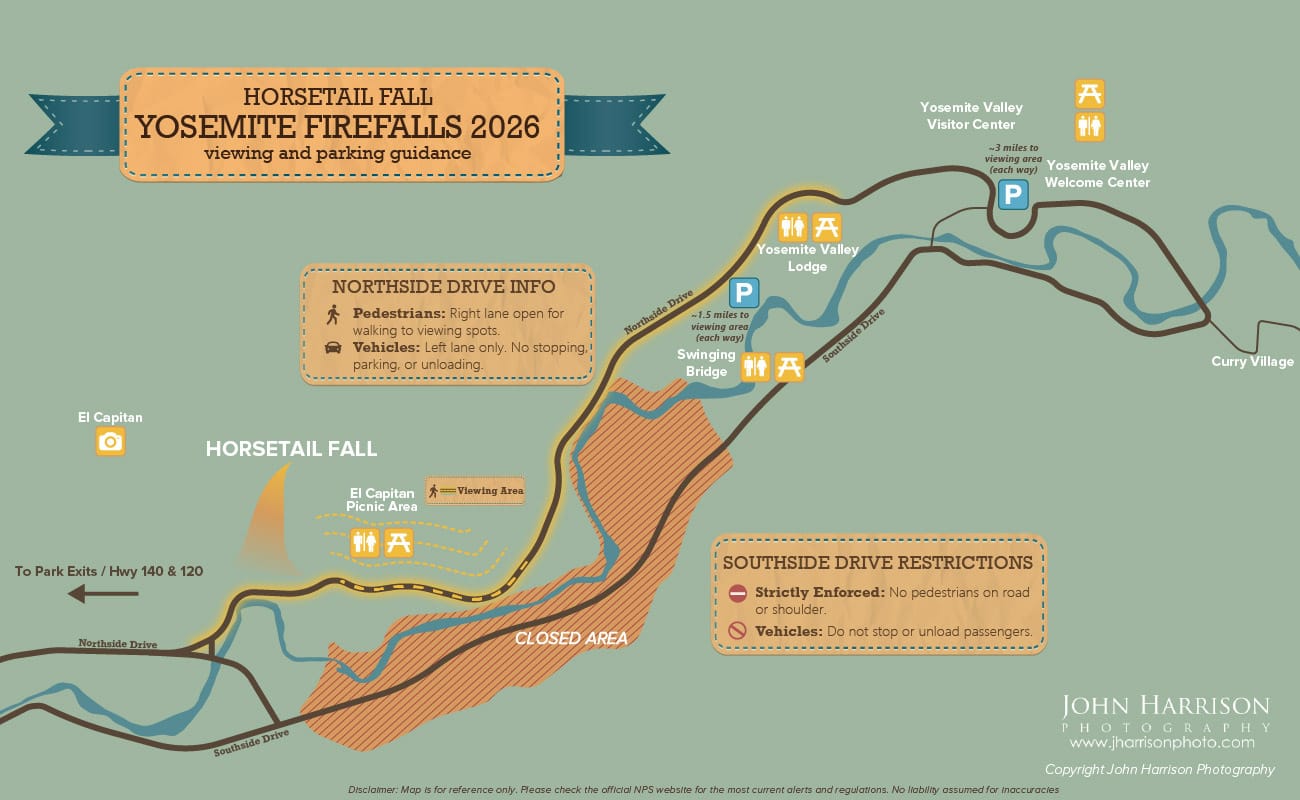
Viewing is primarily from designated areas on the north side of the Valley, roughly across from El Capitan. South-side access is often restricted during Firefall season to protect sensitive areas — always confirm current closures on the NPS page. In 2026 this is restricted per the map below.
Parking (Expect to Walk)
- Yosemite Falls Parking (near Yosemite Valley Lodge): ~1.5 miles each way
- Yosemite Village Parking: ~3 miles each way
- Curry Village Parking: ~3 miles each way
Pro Tip: Since reservations aren't required this year, the Northside Drive corridor will fill up by midday. If you aren't parked by 1:00 PM, consider parking at Yosemite Falls and taking the long walk—it's often faster than sitting in the traffic loop.
Roadside parking near viewing areas is often restricted, and traffic congestion near sunset can be severe. Walking is usually faster — and far less frustrating — than trying to park close.
Conditions, closures, and shuttle availability change year to year.
👉 Always check the official National Park Service page before your visit:
https://www.nps.gov/yose/planyourvisit/horsetailfall.htm
Photographing Horsetail Falls: Camera vs. Cell Phone
One of the most common questions I hear each winter is how to photograph Horsetail Falls. The honest answer is simple:
Photographer bonus: my Firefall settings + shot strategy (free)
My real-world DSLR + iPhone tips, lens choices (24–70 / 70–200), exposure approach, and how I build a print-worthy image when the light changes fast.
✅ Join free and I’ll send it over.
Photographer bonus: my Firefall settings + shot strategy (free)
My real-world DSLR + iPhone tips, lens choices (24–70 / 70–200), exposure approach, and how I build a print-worthy image when the light changes fast.
The best camera is the one you have with you! What your eyes see, what a phone captures, and what a professional camera records are very different experiences.
Phones can capture the moment when the glow is strong and the sky is clear — but most images show only a small highlight on the cliff with limited detail as the light fades. Cameras document the experience; they don’t always isolate it.
That’s why the memory often matters more than the photo.
Why Horsetail Falls Photographs Look So Dramatic
Images like my award-winning Nature’s Firefalls aren’t the result of luck alone. They’re created through:
- Long lenses that compress distance and isolate the waterfall
- Precise timing during a narrow sunset window
- Stable support and careful exposure as light fades
- Long exposures that reveal motion and texture
- Thoughtful, natural processing to create a wall-ready fine art print
As Ansel Adams famously said:
“You don’t take a photograph, you make it.”
If Conditions Don’t Cooperate (And Often They Don’t)
Some years, Horsetail Falls never glows. Some nights, clouds arrive at the worst possible moment. That doesn’t mean your trip was a failure.
Winter Yosemite offers:
- Snow-covered granite and frozen waterfalls
- Quiet mornings and moody skies
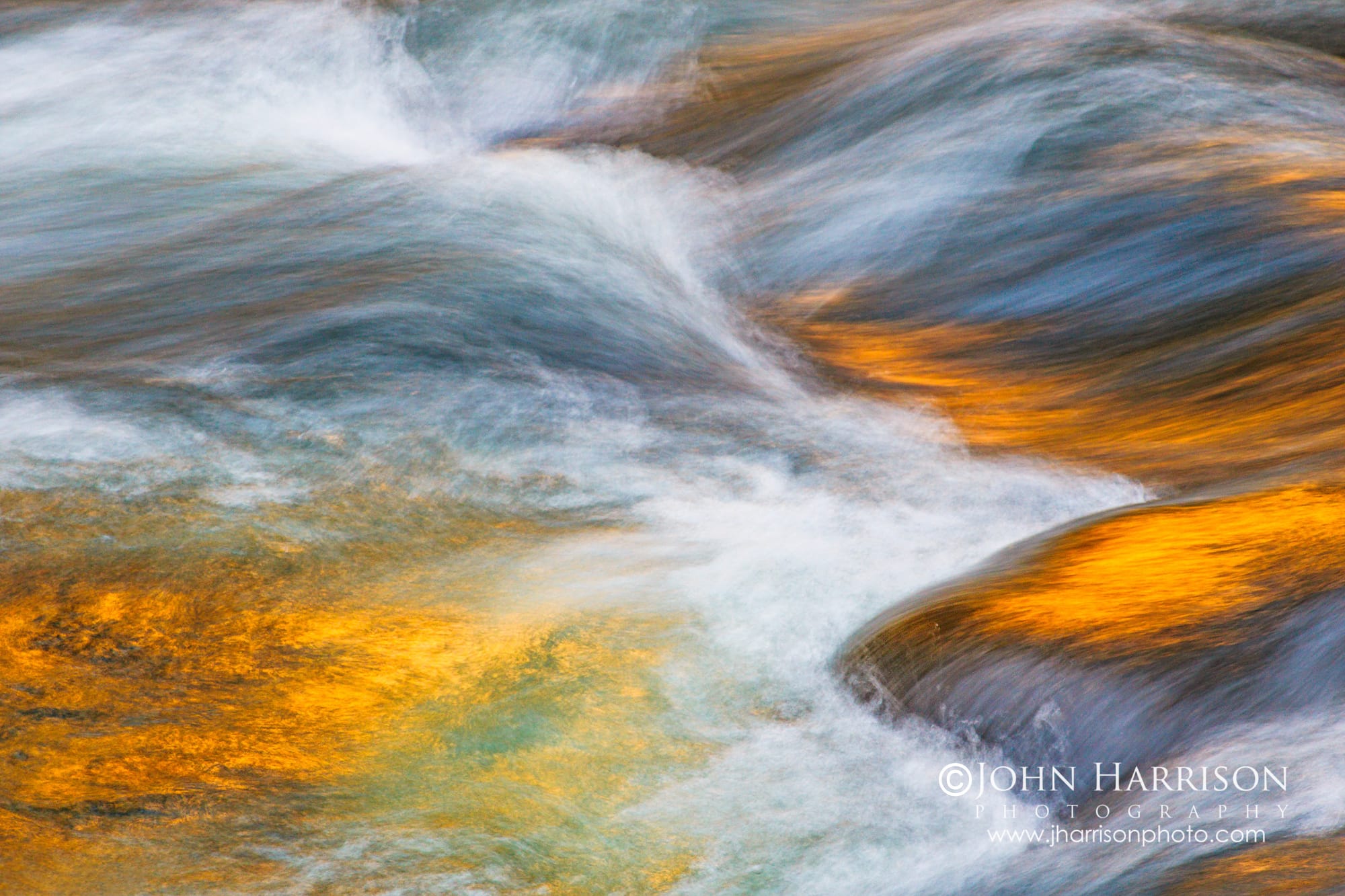
- Reflections along the Merced River
- A stillness that’s increasingly rare
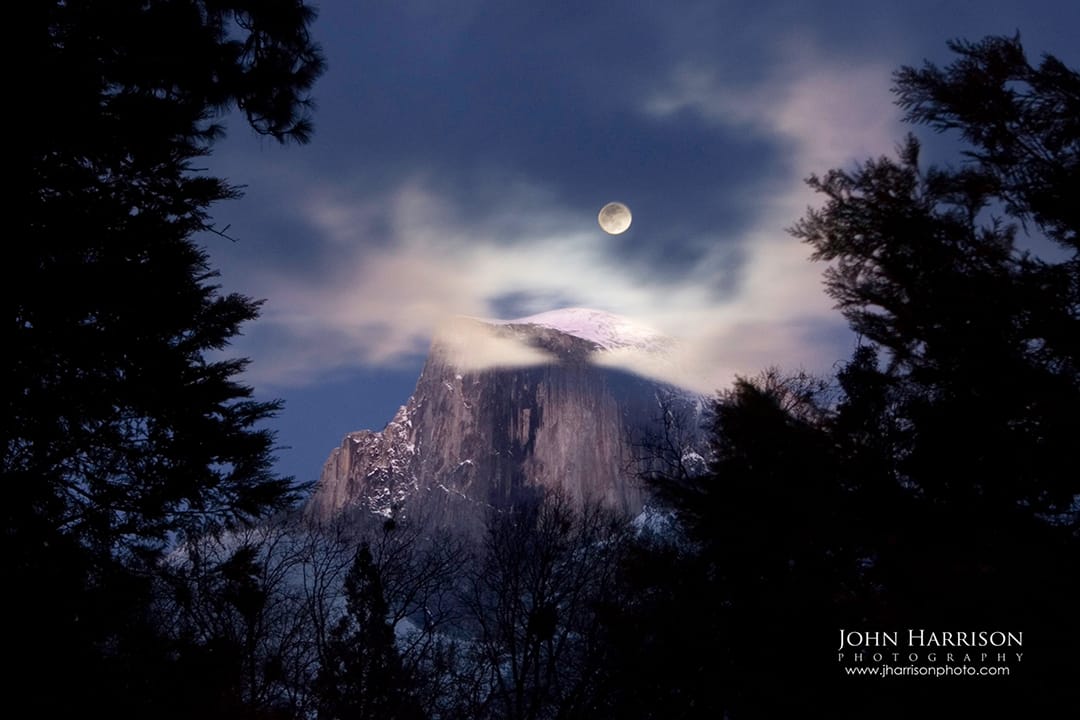
One of my favorite Yosemite images, ‘Full Moon Over Half Dome,’ came from a failed Firefall outing — a reminder that Yosemite still delivers when Firefall doesn’t.
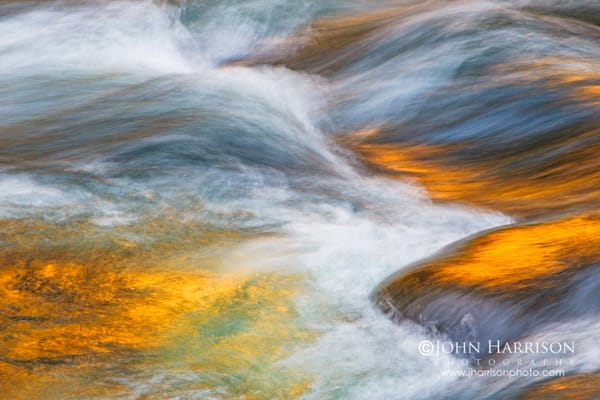
While Horsetail Fall is the main event, the real magic happens when you look for the abstract textures of the Merced River during sunset.
Exhausted by the Yosemite Firefall crowds?
Check out my Yosemite Winter Itinerary for a quieter way to see the park.
Why my “Nature’s Firefalls” Became a Collector Image
I created "Nature’s Firefalls - Horsetail Falls at Sunset" in 2007 — long before Horsetail Falls became a global event. It took multiple trips, years of watching conditions fail, lots of luck and one brief evening when everything finally aligned.
Collectors often tell me it becomes a conversation starter — a moment that stops people mid-sentence. Executives, designers, and healthcare professionals are drawn to it not just for the color, but for what it represents: timing, patience, and rarity. I also have Yosemite lovers who remember the old Fire Falls from Glacier Point who tell me their stories and some who think that is still going on!
This is the photograph I keep in my own office. Not because it’s dramatic, but because it reminds me that the best work — and the best experiences — arrive only when you’re willing to wait.
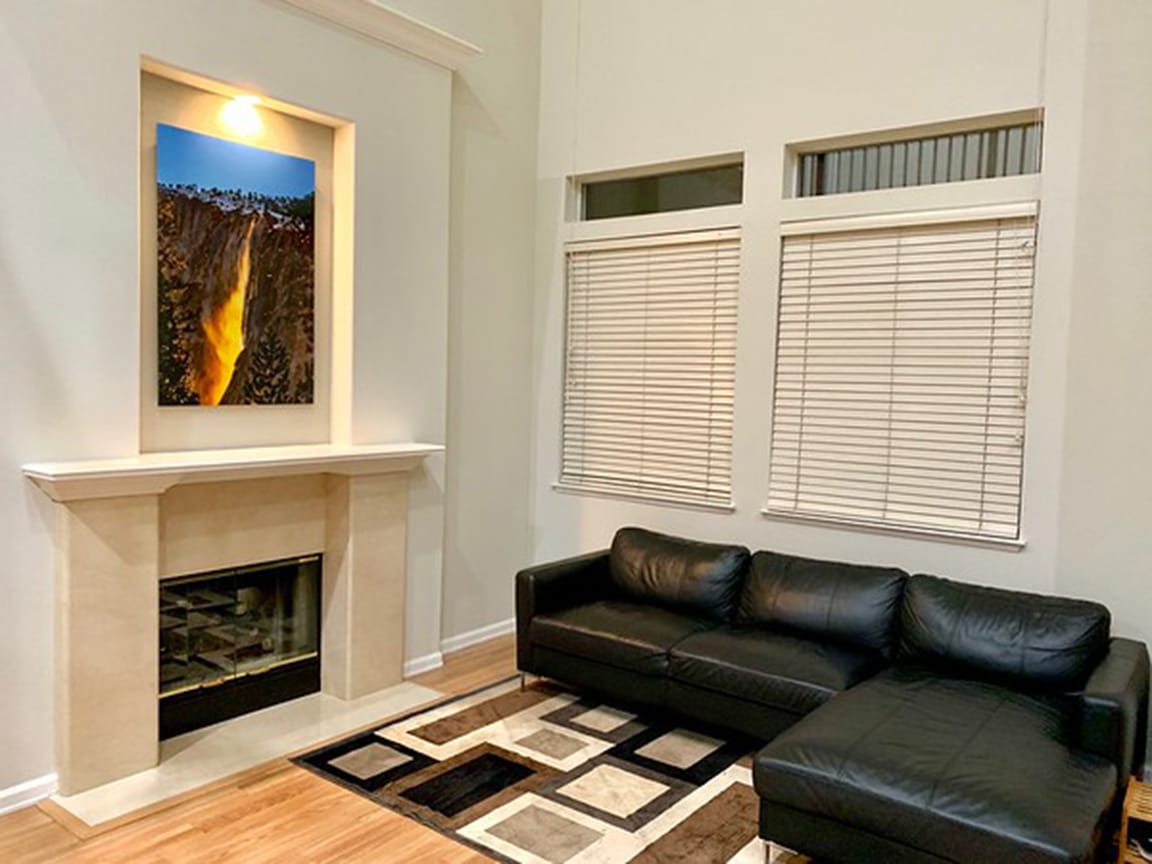
Bring Yosemite Home
For collectors drawn to rare moments, quiet power, and authentic Yosemite light.
Protecting Yosemite (Please Read!)
Horsetail Falls’ popularity has increased pressure on Yosemite’s fragile winter landscapes.
Please help protect what you came to see:
- Stay out of meadows, even when snow-covered
- Remain on trails and hardened surfaces
- Respect closures and ranger instructions
- Pack out everything you bring
- Be patient and considerate in crowded areas
How you move through Yosemite matters just as much as what you photograph.
Final Thoughts: Enjoy Yosemite - If You Go, Go Slowly, Relax, and Look Around
As a longtime Yosemite visitor and lover, Yosemite Firefall is a remarkable moment — but it’s only a small part of Yosemite in winter!
Some evenings, the light never arrives. Other nights, it surprises you. When that happens, look around. Walk beneath snow-covered granite. Visit the Ahwahnee Meadow at night. Let your eyes adjust to a sky free of light pollution.
One of my favorite Yosemite images, "Full Moon Over Half Dome", was created during a failed Firefall outing! Conditions didn’t align for Horsetail Falls, but the Valley offered something else — a quiet winter night, drifting clouds, and a glowing full moon rising behind Half Dome. I set up quickly (in the middle of the road!), made just a few frames, and then the moment was gone.
That image became a reminder I carry with me every winter:
Yosemite always gives you something — if you’re willing to slow down and pay attention.
Yosemite in winter remains one of my favorite experiences here — silence, stars, and no crowds!
And if conditions didn’t align during your visit, you can still bring Yosemite home.
You can explore my Yosemite and Horsetail Falls fine art prints — created with patience, experience, and deep respect for this place — at my gallery anytime.
If Horsetail Falls inspires you to visit, let it also teach you how to see Yosemite — not as a checklist, but as a place worth waiting for.